


Beyond the Survey: Why Journey Management Beats Voice of Customer Alone
1. Executive summary
Most Voice of Customer (VoC) programs were built for a world where customers answered surveys and experiences happened in one or two channels. Neither holds today. Qualtrics XM Institute reports that only three in ten consumers give companies direct feedback, an all-time low [1]. McKinsey found that while almost every CX leader relies on survey-based metrics, only 4 per cent can calculate the return on their CX decisions [3].
Our view is blunt: survey-led VoC is now a rear-view mirror. The advantage has shifted to organisations that manage end-to-end journeys as a live system, combine VoC with behavioural and operational data, and use AI to predict where customers will struggle next, funding fixes before the scores fall.
The evidence has been building for a decade. Journey performance predicts satisfaction and churn far better than touchpoint scores [4]. Organisations using predictive journey analytics report double-digit cuts in cost-to-serve and churn [3]. A new class of journey management platforms, such as JourneyTrack, now makes this practical by linking insight, action and business outcome in one governed place [9][10].
This is not an argument to switch off surveys. It is an argument to demote them from the steering wheel to one instrument on the dashboard.
Key takeaways
- Survey response is falling every year, so survey-only VoC sees less of the customer each year it runs.
- Journeys, not touchpoints, are the unit that predicts loyalty, churn and cost.
- Insight without owned, tracked action is the main reason VoC programs stall.
- AI's real value is foresight: predicting behaviour and expectations across the whole journey, not summarising last quarter's comments.
- Journey management platforms make the shift operational; the hard part is the operating model around them.
2. The dashboard is green and the customers are leaving
Picture a familiar quarterly review. Post-call satisfaction is steady at 82 per cent. NPS ticked up two points. The VoC team has a tidy deck of verbatim themes. Meanwhile, the finance team is reporting that early-life churn has quietly risen for three quarters running, and nobody in the room can connect the two.
This gap is not a failure of effort. It is a failure of design. Traditional VoC programs were built to listen at moments: after a call, after a purchase, once a year in a relationship survey. They answer the question "how did that interaction feel?" well. They answer "what will this customer do next, and why?" poorly or not at all.
Three forces have widened the gap.
Customers have stopped talking to us. Qualtrics XM Institute's 2026 research, drawn from 20,000 consumers in 14 countries including Australia, finds only three in ten customers now give direct feedback [1]. Its researchers note that willingness to give feedback has dropped every year since they began tracking it in 2021, and that the only rising response is customers telling no one at all [2]. A shrinking, self-selecting sample is a weak basis for multimillion-dollar decisions.
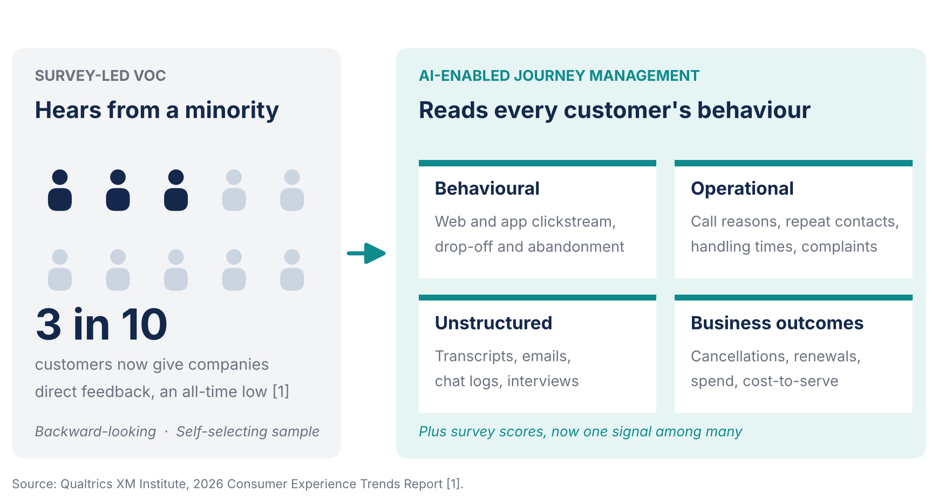
Figure 1: Survey-led VoC hears from a minority; journey management reads what every customer does.
Experiences now span many channels, and they break at the seams. A customer might research on a website, start an application in an app, get stuck, call, and receive a letter. Each touchpoint can score well while the journey fails, a distortion McKinsey partners first documented more than a decade ago [5]. McKinsey's research across 27,000 consumers found that journey performance is 35 per cent more predictive of customer satisfaction, and 32 per cent more predictive of churn, than performance on individual touchpoints [4].
Experience quality is sliding regardless. Forrester's 2025 CX Index found that across Australia, Singapore and India, 37 per cent of brands' CX scores fell while just 5 per cent rose [6]. In its 2024 Australian study, not one of the 30 banks, investment firms, super funds or government agencies studied improved, and all ten government agencies ranked "poor" or "very poor" [7]. Most of these organisations run VoC programs. The programs measured the decline; they did not prevent it.
3. Why the usual answers fall short
When VoC programs disappoint, organisations tend to reach for three remedies. Each treats a symptom.
More surveys, better designed. Shorter questionnaires, smarter triggers, incentives. These can lift response for a while, but they fight a structural trend: the more organisations ask, the less customers answer [2]. More importantly, a better survey is still a survey. McKinsey sets out four limits that no amount of questionnaire design fixes [3]:
- A typical CX survey samples about 7 per cent of a company's customers, and only 13 per cent of CX leaders are fully confident their system gives a representative view.
- Surveys describe what already happened. Nearly two-thirds of CX leaders rank near-real-time action as a top priority; only 13 per cent are confident their systems can deliver it.
- Only 16 per cent say surveys give them data granular enough to address root causes.
- The link between scores and business outcomes is poorly understood, which is why only 4 per cent can calculate the ROI of CX decisions.
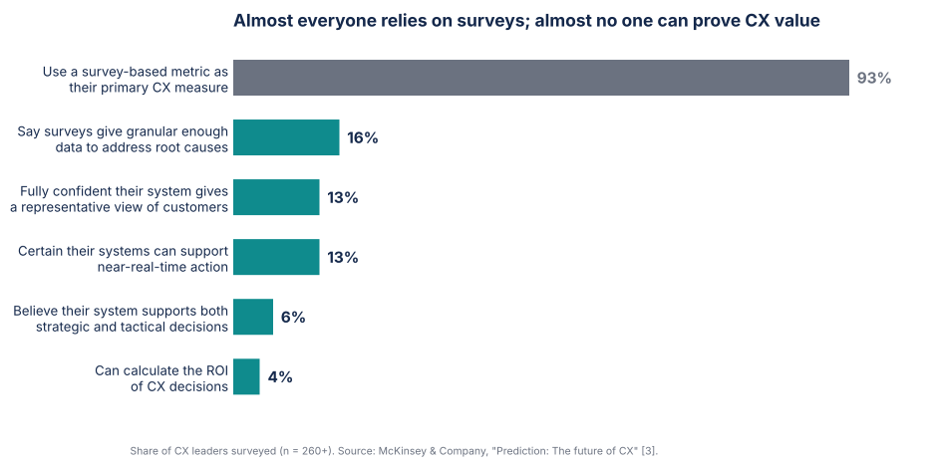
Figure 2: What CX leaders told McKinsey about their survey-based measurement systems [3].
Better dashboards and text analytics. AI-powered theme detection is a genuine improvement. It turns thousands of comments into themes in minutes. But if the input is still post-interaction survey text, the output is still a faster summary of the past. Speed of hindsight is not foresight.
Journey maps on the wall. Many organisations have invested in journey mapping workshops and produced beautiful artefacts. Then the maps go into a shared drive and age. A map built from a 12-week research project describes the journey as it was, not as it is, and it rarely owns a single KPI. JourneyTrack's own framing is useful here: a journey map is a snapshot, while journey management works more like GPS, continuously updated and guiding the next move [11].
Underneath all three sits the problem Forrester identifies in its 2025 study of VoC practice: the biggest struggle is not collecting insight but getting stakeholders to act on it, and many programs lack stakeholders' confidence in their insights at all [8]. A VoC team that can describe pain but cannot assign, fund or track the fix will always be a reporting function, not a performance function.
4. From listening to anticipating: four shifts
We think the way forward is not a better VoC program but a different management system, one in which VoC is a vital input rather than the whole story. We describe it as four shifts.
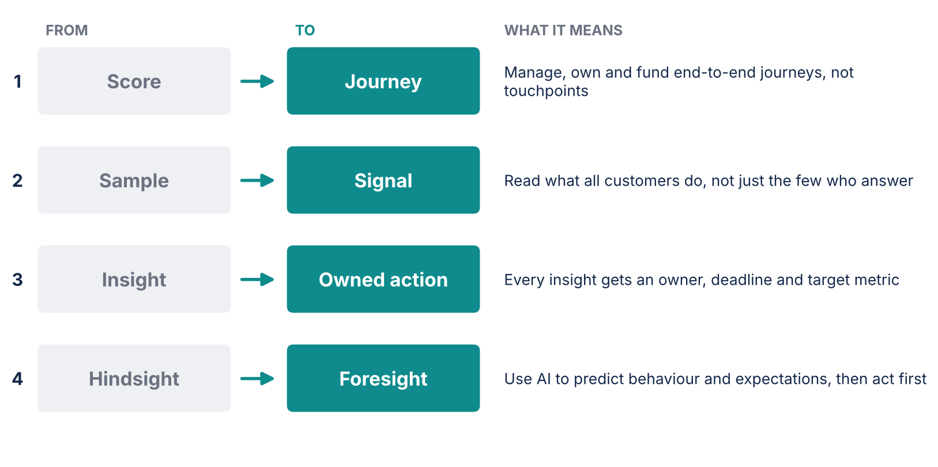
Figure 3: The four shifts from survey-led VoC to AI-enabled journey management.
- From score to journey
Make the end-to-end journey, not the touchpoint, the unit you measure, own and fund. In practice that means a small set of priority journeys (onboarding, claims, renewal, complaints, hardship) each with a named owner, a shared KPI set and a live view of performance across channels. McKinsey's research suggests three to five journeys matter most to customers and the bottom line in any industry, and that maximising journey satisfaction can lift revenue by up to 15 per cent while cutting cost-to-serve by up to 20 per cent [4].
- From sample to signal
Stop relying on the 7 per cent who answer and start reading what all customers do. Combine survey scores with behavioural data (web and app analytics, drop-off points), operational data (call reasons, handling times, repeat contacts, complaints) and unstructured text (transcripts, emails, interviews). Behaviour is the feedback that customers give whether or not they fill in a form. The customers who never respond are often the ones most likely to leave.
- From insight to owned action
Every insight should carry a recommendation, every recommendation an owner, a deadline and a target metric, and every completed action a measured result. This closes the loop that VoC programs promise but rarely deliver, and it is what wins back executive attention. As one bank executive put it, journey work can quietly die once executive support fades; keeping the focus on outcomes and tracking is what keeps executives engaged [11].
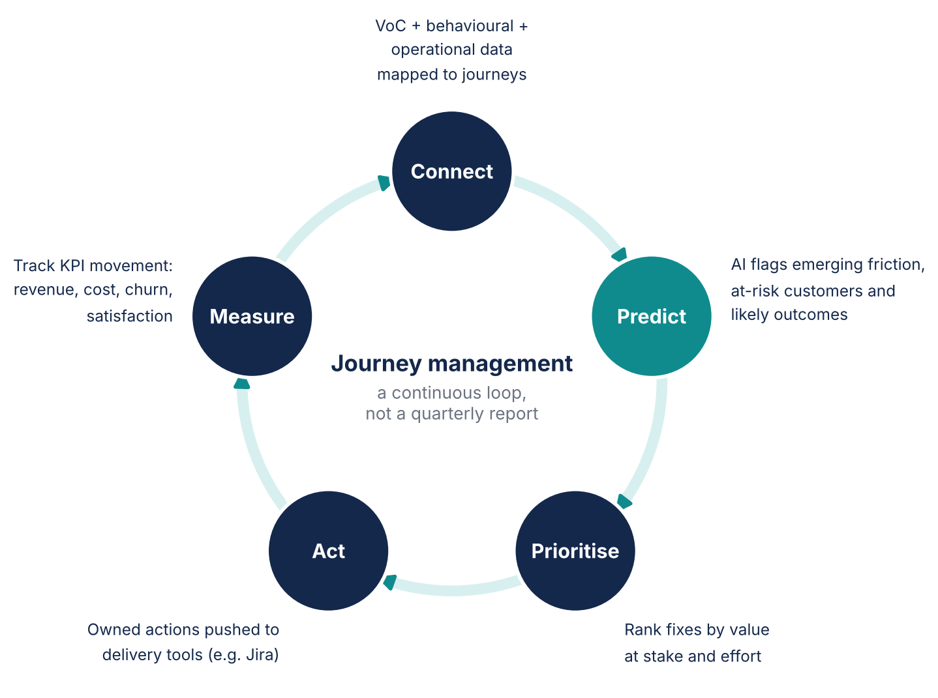
Figure 4: Journey management as a continuous loop, with AI prediction at its centre.
- From hindsight to foresight
This is where AI changes the economics. Used well, AI does not just summarise last quarter's comments. It models which journey signals precede churn, complaints or failed applications, scores customers and journeys on likely future outcomes, and flags emerging friction before it shows up in satisfaction scores. McKinsey describes organisations that use machine learning to detect specific events in customer journeys and to anticipate behaviour, in some cases scoring satisfaction and predicted value for every customer, every day [3].
Foresight also applies to expectations. Customer standards are set by their best experience anywhere, not by your competitors. Predictive models trained on whole-journey data can show where expectations are drifting (for example, rising digital self-service, falling tolerance for wait times) before a survey would surface them as complaints.
The point of prediction is a better decision: which journey to fix first, which customers to contact proactively, and what result to expect before money is committed. JourneyTrack, for instance, frames its platform around exactly that question of what outcome a team can expect before it invests [10].
5. The maturity path
JourneyTrack describes the market's evolution in three waves, which matches what we see in practice [11]:
- Journey mapping in slides and whiteboards: valuable, but static and disconnected from data.
- AI-assisted journey management: journeys connected to live VoC, behavioural and operational data, with AI generating insights and recommendations, and action plans tied to KPIs.
- Autonomous journey optimisation through agentic AI: AI agents that continuously monitor journey data streams, detect deviations from the intended path, recommend or trigger interventions such as raising a ticket for the right team, and keep humans in the loop for oversight.
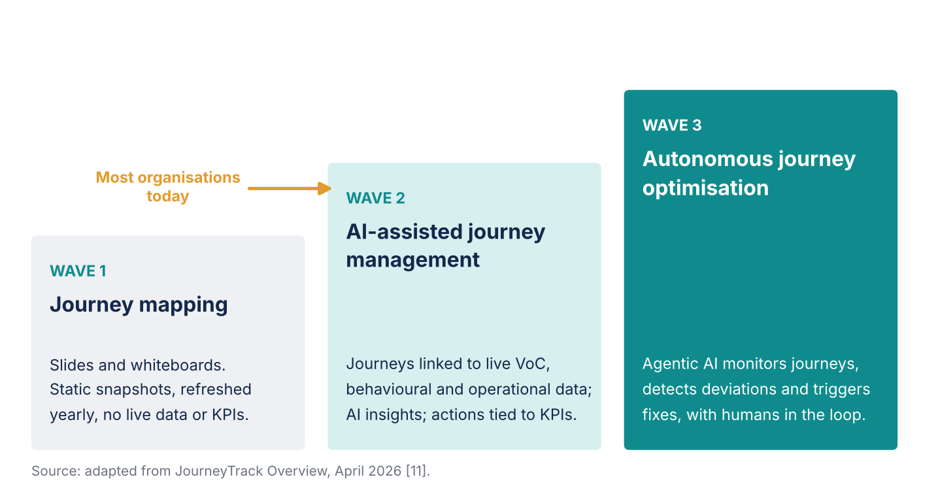
Figure 5: Three waves of journey maturity.
Most organisations still sit somewhere between waves one and two. The third wave is emerging rather than mainstream, and it raises governance questions that boards should be asking now.
6. Side by side: survey-led VoC and journey management
The difference is not the technology. It is what the organisation manages, and what it holds people accountable for.
|
Dimension |
Traditional VoC program |
AI-enabled journey management |
|
Unit of management |
Touchpoint or transaction score |
End-to-end journey with a named owner |
|
Data |
Surveys from a small, self-selecting sample |
VoC plus behavioural, operational and unstructured data across all customers |
|
Time orientation |
Backward-looking: what happened last period |
Forward-looking: what is likely to happen next, and where |
|
Role of AI |
Text analytics and theme summaries |
Prediction, prioritisation, recommendations and, increasingly, agentic monitoring |
|
Output |
Reports, dashboards, verbatim themes |
Prioritised, owned actions linked to KPIs and delivery tools such as Jira or Asana |
|
Link to value |
Correlation assumed, ROI rarely calculated |
Actions tracked against revenue, cost, retention and satisfaction |
|
Cadence |
Monthly or quarterly reporting; journey maps refreshed annually |
Continuous; journeys update as live data arrives |
|
Typical owner |
CX or insights team |
Journey owners across business units, supported by CX |
Two cautions. First, journey management does not replace VoC; it depends on it. Platforms like JourneyTrack draw live data from VoC tools such as Qualtrics, Medallia and Forsta, and from analytics and data platforms such as GA4, Adobe Analytics, Snowflake and BigQuery [11]. Second, a platform does not create accountability on its own. The journey owners, governance and funding rules come first.
7. What good looks like: six cases
The cases below come from two kinds of source. The first three are published by McKinsey and show what predictive, journey-level analytics can achieve. The last three are customer stories reported by JourneyTrack; the results are vendor-reported and we present them as such.
- An airline: predicting satisfaction for every customer, every day
An airline built a machine-learning system that uses around 1,500 variables to score satisfaction and predicted revenue for more than 100 million customers daily, without waiting for a survey. Its first application, targeting dissatisfied high-value customers, delivered an 800 per cent uplift in satisfaction and a 60 per cent reduction in churn among priority customers. A team of 12 to 15 people built it in about three months [3].
The lesson: prediction lets you act on the customers who would never have told you they were unhappy.
- A credit-card issuer: 13 journeys, 10 to 25 per cent lower costs
A credit-card company built a data and analytics capability covering 13 priority journeys, which let it focus investment on the journeys and moments that actually mattered to customers. It reduced interaction and operational costs by 10 to 25 per cent [3].
The lesson: a journey lens turns CX from a cost into a lever on cost-to-serve.
- A US healthcare payer: a "journey lake" across nine systems
A health insurer synchronised around four billion records from nine systems into a single journey view. It used the insight to reduce by more than a quarter how often customers who started online switched to another channel, cutting cost in the process [3].
The lesson: channel-switching is invisible in touchpoint surveys and obvious in journey data.
- An integrated health system: from siloed teams to shared journey KPIs
A health system serving more than five million members faced fragmented journeys, low digital engagement, high call volumes and declining satisfaction. Working with JourneyTrack, it mapped its priority journeys (onboarding, claims, care navigation and chronic support), assigned owners and shared KPIs, integrated VoC and analytics into each journey stage, and turned insights into prioritised action plans. Within nine months it reported a 17 per cent increase in digital engagement, a 19 per cent reduction in claims and benefits calls, a nine-point NPS increase on high-impact journeys, and time-to-market for new initiatives cut from six months to ten weeks [11].
The lesson: shared ownership and shared metrics, not better maps, produced the result.
- Associated Bank: keeping executives engaged by tracking outcomes
Associated Bank's retail experience team uses JourneyTrack's action planning to turn journey findings into agreed actions with owners and deadlines, and to review progress with executives. Its SVP of retail experience delivery observed that journey programs often fade when executive support is lost, and that a focus on outcomes and tracking is what holds executive attention [11].
The lesson: the loop from insight to action to result is what keeps CX funded.
- A global pharmaceutical company: retention in clinical trials
A pharmaceutical company running multi-region clinical trials held patient feedback, site reports and research data in disconnected systems and could not see where participants dropped out. It mapped trial journeys from recruitment to exit, built personas for patients, physicians and coordinators, centralised Qualtrics survey data and interviews in one insights hub, and overlaid trial KPIs such as retention and protocol adherence on its journey actions. It reported a double-digit increase in retention and more than 100 hours saved per trial phase [11].
The lesson: the approach works well beyond retail customers: for patients, members and citizens too.
8. The benefits, in business terms
Across the published evidence and these cases, the benefits of moving from survey-led VoC to AI-enabled journey management fall into six groups.
- Lower cost-to-serve. Fixing journeys removes failure demand: the calls, emails and repeat contacts caused by something not working the first time. The cases above show reductions of 10 to 25 per cent in interaction and operating costs [3] and a 19 per cent fall in claims and benefits calls [11].
- Lower churn and higher lifetime value. Prediction finds at-risk customers who never complain. Journey-level performance is 32 per cent more predictive of churn than touchpoint performance [4], and the airline case shows what targeted intervention can do [3].
- Revenue growth. McKinsey estimates that maximising satisfaction on customer journeys can lift revenue by up to 15 per cent [4]. Digital engagement gains, like the 17 per cent increase in the health system case, compound over time [11].
- Provable ROI. When every action is linked to a journey KPI, CX leaders can show which investments moved which numbers. That matters when only 4 per cent of CX leaders can currently calculate CX ROI [3] and CX budgets face scrutiny.
- Faster, cheaper journey work. AI reduces the manual effort of building and refreshing journeys. Paychex reported halving its journey mapping time from 16 weeks to eight, which it estimates saved more than US$1 million across 60-plus journeys [11].
- Better governance and alignment. A single, governed system of record for journeys, insights and actions reduces duplicated effort, gives executives one view of experience performance, and supports auditability, an increasing concern as AI begins recommending and triggering actions.
For public sector leaders, the same logic applies with different words: fewer avoidable contacts, earlier support for people at risk of falling through the cracks, and evidence that service improvements deliver the outcomes ministers and communities expect.
9. Where to start
The shift does not need a big-bang program. It needs a well-chosen first journey and the discipline to close the loop on it.
- The first 90 days
- Pick two or three priority journeys. Choose them by value at stake (revenue, cost-to-serve, churn or, in government, public outcomes) and by how much evidence you already hold. Name a single accountable owner for each.
- Audit what you already know. List every data source that touches those journeys: VoC surveys, contact centre reasons, digital analytics, complaints, CRM events. Most organisations hold far more journey signal than their VoC team uses.
- Connect, don't collect. Bring those sources into one journey view, whether in a journey management platform or a well-governed data model, before commissioning any new survey.
- Define the outcome metrics up front. For each journey, agree two or three business KPIs that the work must move, and baseline them now.
- Build one predictive use case. Start narrow: which signals in the onboarding journey precede early cancellation, or which contact patterns precede a complaint. Prove the model on a pilot cohort before scaling.
- Run the loop visibly. Turn insights into owned actions in the delivery tools your teams already use, track them to completion and report the KPI movement to executives monthly.
- Questions boards and executives should ask
- What share of our customers does our VoC program actually hear from, and who are we missing?
- Which three to five journeys drive most of our revenue, cost and risk, and who owns each end to end?
- Can we show the measured business result of the last ten CX improvements we funded?
- Which customer behaviours predict churn or complaints today, and how early can we see them?
- How long does it take for a customer insight to become a funded, owned action?
- If AI begins recommending or triggering journey interventions, what oversight, auditability and privacy controls will apply?
10. Take your eyes off the mirror
Back in that quarterly review, the satisfaction score was never wrong. It was simply answering a smaller question than the one the business needed answered. Surveys will remain a valuable instrument for hearing customers in their own words. But organisations that want to keep customers, cut cost-to-serve and prove the value of CX need to manage the whole journey, read every signal customers leave behind, and use AI to see what is coming.
The customers who stop answering your surveys are still telling you what they think. They are just telling you with their behaviour.
- References
- Qualtrics XM Institute, 2026 Consumer Experience Trends Report, 2025. com
- MarTech, "Declining customer feedback and loyalty, growing AI skepticism" (on Qualtrics XM Institute research), 2024. org
- McKinsey & Company, "Prediction: The future of CX", McKinsey Quarterly. com
- McKinsey & Company, "The three Cs of customer satisfaction: Consistency, consistency, consistency". com
- Rawson, A., Duncan, E. and Jones, C., "The Truth About Customer Experience", Harvard Business Review, September 2013. org
- Forrester, "Customer Experience Quality In The US Falls To An(other) All-Time Low" (CX Index 2025 results), 2025. com
- Forrester, "Forrester's 2024 Australia CX Index: Overall CX Quality In Australia Continues To Decline", 2024. com
- Forrester, Summary: The State Of Feedback Management (VoC) And CX Measurement, 2025, August 2025. com
- Forrester, The Forrester Wave: Customer Journey Management Platforms, Q4 2025, November 2025. com
- JourneyTrack, company website, accessed November 2026. io
- JourneyTrack, JourneyTrack Overview, April 2026 (vendor presentation; customer results are vendor-reported).

